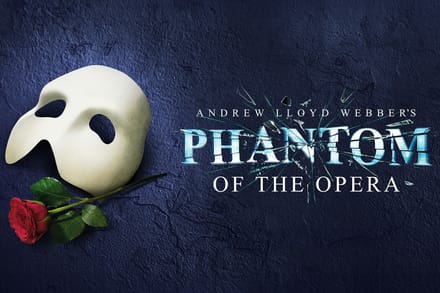
The Phantom of the Opera has been playing at His Majesty's Theatre in London's Haymarket since 1986, making it one of the longest-running productions in the history of the West End. Andrew Lloyd Webber's musical, based on Gaston Leroux's 1910 novel, has become one of the defining works of the form: a gothic love story set within the Paris Opera House, built around a score that is among the most recognised in musical theatre. This guide covers everything you need to know before booking.
The Phantom of the Opera tells the story of Christine Daaé, a soprano at the Paris Opéra, and the mysterious masked figure who haunts the building's labyrinthine lower levels. The Phantom, a musical genius disfigured from birth and consumed by obsession, has been secretly tutoring Christine and falls deeply in love with her. When Christine is reunited with her childhood friend Raoul, now a Vicomte and a patron of the opera, the tension between the three central characters builds towards a confrontation that is one of the most emotionally charged in the repertoire.
The story is gothic in character: the underground world of the Paris Opera, the Phantom's lair beneath a subterranean lake, and the dramatic unmasking that drives the second half of the show are all designed to produce an atmosphere unlike anything in the standard musical theatre canon. The emotional core of the show, however, is the relationship between Christine and the Phantom: a portrait of obsessive love, artistic mentorship and the moral weight of beauty and ugliness.
The score is the central reason The Phantom of the Opera has held its West End home for so long. Andrew Lloyd Webber wrote it in 1986 in collaboration with lyricists Charles Hart and Richard Stilgoe, drawing on operatic traditions that are reflected both in the setting and in the vocal demands placed on the principal performers. The music ranges from sweeping romantic themes to comic opera pastiche to psychological intensity.
The show's title theme, with its famous pipe organ opening, is one of the most immediately recognisable pieces of music in twentieth-century popular culture. Beyond it, the score is notable for its sustained dramatic range: songs like "The Music of the Night," "All I Ask of You" and "The Point of No Return" carry real emotional weight and serve the story rather than existing as standalone set pieces.
The Phantom of the Opera runs for approximately two hours and thirty minutes, including one interval. The interval falls roughly midway through the story, at a point designed to leave the audience in anticipation of the show's second half.
The recommended age guidance is seven years and above. The show contains some dramatic and emotionally intense scenes, particularly those involving the Phantom's unmasking and the climactic confrontation, and these elements can be distressing for younger children. For children around seven to ten, parental discretion is sensible; the show is in no sense graphic, but it has a sustained darkness of tone that lighter family shows do not. From approximately ten years upward, The Phantom of the Opera is generally well suited to younger audience members and is frequently a first major theatrical experience for older children.
Under-fives are not admitted to the performance.
His Majesty's Theatre stands on the Haymarket in central London, one of the most historically significant theatres in the West End. The current building dates from 1897, designed by Charles J. Phipps and reconstructed in a distinctive French Renaissance style that gives the exterior a character unlike most of its Theatreland neighbours. The theatre has been through several name changes as the monarchy has changed over its history; during a queen's reign it becomes Her Majesty's Theatre, returning to His Majesty's when the monarch is a king.
Inside, the auditorium has the grandeur of a late Victorian theatrical interior: decorated boxes, ornate plasterwork and a sense of occasion that suits the material extremely well. The Phantom of the Opera has occupied the theatre since its opening, and the production design is integrated into the building in ways that would be difficult to replicate elsewhere. The theatre seats approximately 1,216 people across four levels.
For more on theatres in the West End, browse the venue listings on BritishTheatre.com.
His Majesty's Theatre has four seating levels: Stalls, Royal Circle, Grand Circle and Balcony.
Stalls is the ground level and provides the closest proximity to the stage. For The Phantom of the Opera, the mid-Stalls central seats offer an excellent view of the performance and are close enough to the action to feel fully immersed in the production. The very front rows involve a steeper upward viewing angle, and some of the most dramatic scenic effects are designed to be seen from further back in the house. Row A to C in the Stalls is not ideal for first-time attendees; rows E to M central are the most satisfying positions at this level.
Royal Circle is the first balcony and is widely regarded as offering some of the finest seats in the house for this production. The elevated perspective allows the full staging to be appreciated, and the distance from the performers, while greater than the Stalls, remains close enough to engage with the details of the performances. The front rows of the Royal Circle central section are among the most sought-after seats in the building.
Grand Circle provides a wider panoramic view and is a reliable and affordable option. The staging of The Phantom of the Opera uses the full width and depth of the stage, and the Grand Circle perspective allows the large scenic elements to be taken in fully. Sound quality carries effectively to this level.
Balcony is the highest level and the most affordable. The distance from the stage is significant, but for a production of this visual scale, the Balcony remains a workable option, particularly for those who have seen the show before and are more interested in the music than in the close detail of the performances.
Restricted-view seats exist on the sides of several levels. These are clearly marked during the booking process and are sold at a reduced price to reflect the limitation. For a first visit, a central position in any level is strongly preferable to an unrestricted side seat at a cheaper price.
His Majesty's Theatre is at the junction of Haymarket and Charles II Street in the West End, approximately a ten-minute walk from Trafalgar Square and within easy reach of several Underground stations.
Piccadilly Circus (Bakerloo and Piccadilly lines) is approximately a five-minute walk north along the Haymarket.
Charing Cross (Bakerloo and Northern lines, as well as National Rail) is approximately ten minutes on foot, approaching from Trafalgar Square.
Leicester Square (Northern and Piccadilly lines) is also within comfortable walking distance via Coventry Street or Panton Street.
There is no direct car parking immediately adjacent to the theatre. The area is busy in the evenings, and public transport is the practical choice for most visitors. Several car parks are available within ten to fifteen minutes' walk in the surrounding streets of the West End.
Book early for the best seats. The Phantom of the Opera is one of the most consistently popular productions in the West End, and the best central positions in the Royal Circle and mid-Stalls sell well in advance of popular performance dates, particularly at weekends and during school holiday periods.
Arrive early. His Majesty's Theatre has a busy foyer and bar area on performance evenings. Arriving thirty to forty minutes before curtain allows time to collect tickets, buy a programme and pre-order interval drinks without rushing.
Programmes. The Phantom of the Opera has one of the more richly produced programmes of any West End show, with detailed notes on the history of the production and the creative team. Worth buying for a first visit.
Photography. No photography or recording of any kind is permitted during the performance.
Interval drinks. Pre-ordering at the bar on arrival means you can collect drinks immediately at the interval rather than joining the queue. Most West End theatres including His Majesty's offer this service.
The Phantom of the Opera occupies a distinctive position in the West End programme because of its operatic scale and its gothic atmosphere. Those who enjoy it often find themselves drawn to shows with a similar sense of dramatic ambition.
Les Misérables at the Sondheim Theatre is the closest comparison in terms of epic scope and emotional weight. Both shows run for approximately the same duration, both are driven by a central male character whose obsession shapes the narrative, and both have scores of genuine sophistication. Les Misérables has a more overtly political and social dimension; Phantom is more intimate in its focus.
For tickets to The Phantom of the Opera and other West End shows, tickadoo covers full availability across the programme.
How long is The Phantom of the Opera? The running time is approximately two hours and thirty minutes, including one interval.
What age is The Phantom of the Opera suitable for? The recommended age guidance is seven years and above. The show has a sustained dark and dramatic tone, and for children between seven and ten, parental discretion is advised. Under-fives are not admitted.
Where is The Phantom of the Opera playing in London? The Phantom of the Opera plays at His Majesty's Theatre, Haymarket, London. It has been at this theatre since it opened in 1986.
What are the best seats for The Phantom of the Opera? The front rows of the Royal Circle central section and mid-Stalls central seats (rows E to M) offer the most satisfying combination of proximity and a clear view of the full staging. The Grand Circle central section is the best-value option and provides a clear overview of the production's visual scale. Check current seat availability on tickadoo.
Do I need to know anything in advance to enjoy The Phantom of the Opera? No prior knowledge of the story or the music is required. The show tells its own story clearly from the opening scene. Some familiarity with the score enhances the experience but is not necessary for a first visit.
Is The Phantom of the Opera suitable for children? Yes, for children aged seven and above. Older children who enjoy drama and music tend to respond very strongly to the show. The recommended lower limit is seven; under-fives are not admitted.
Stay in the spotlight
Get the latest theatre news, reviews and exclusive offers straight to your inbox.