Carmen Disruption
Almeida Theatre
20 April 2015
4 Stars
I did not notice when the blood began to pool around the dead Bull. I did not notice when the Bull stopped breathing.
But there it was: the last breath gone, the black, viscous blood, moat-like around the carcass. Something greatly significant had happened directly in front of me. I had not noticed. It was not that I was not paying attention: I was. But there were other things, compelling, distracting, refocussing my attention. How does one determine what one should focus on in a world that is endlessly changing, populated by fascinating, exotic people. A world without clear signs, obvious endings; a place where you can't use social media for guidance?
This is Michael Longhurst’s revelatory, hallucinogenic, and utterly compelling production of Simon Stephens’ Carmen Disruption, a reworking of a play first performed in 2014 at Deutsche Schauspielhaus in Hamburg. Stephens was encouraged to write the play by a German collaborator, Sebastian Núbling, following long discussions with Rinat Shaham, an international Opera singer whose successful artistic career sees her travel all over the world playing the role of Carmen. Stephens was struck by the particular, disconnected and peripatetic life that Shaham leads – so much travel, so few roots, so many new situations to adapt to, and so much reliance upon social media, and especially IPhones.
Stephens sees Shaham's situation as but a specific reflection of wider concerns: the destruction of community, the isolation of individuals, the globalisation and sterilisation of culture, the power of money and capitalist dreams, the despair that comes from non-intervention. Operatic themes. Taking Bizet’s Carmen as a kind of starting point, Stephens throws those elements, together with the characters and some of the music and plot points from Carmen, into a blender, creating a dystopian present-day landscape where pretty much anything can and does happen.
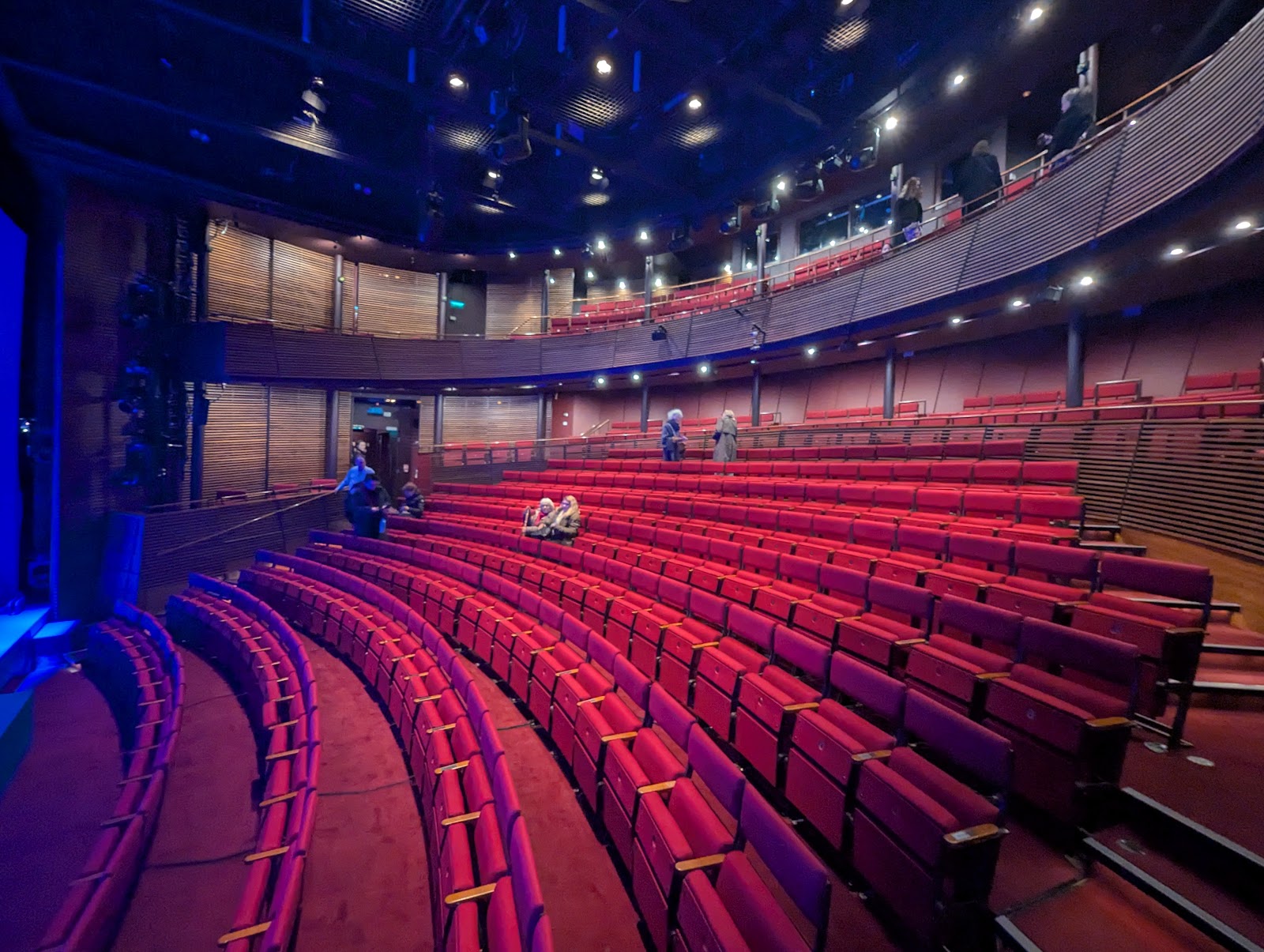
The main characters from Carmen all appear on a desolate, decaying Opera House stage. The sense of glamorous past is ever-present: the wonky chandelier, the faded gold trim, the worn plush red velvet seating. A small duo of Cellos sits to one side, adding musical assistance throughout. And, front and centre, there is the huge, life-like carcass of a dying bull, its breath slowly escaping as the play begins. Yes, this represents the creature from the bullring in Carmen, but it is also a permanent metaphor for the bull market which is critical to Capitalism and the "Bull" of a different kind which pervades modern life everywhere as people obfuscate to survive or make their lives more interesting.
With clever lighting from Jack Knowles, the stage area transforms from opera ghost house to demented bullring to subway horrorscape to dread suburban jungle. Modern society lives and thrives on the shadows, darkness ever present, and the staging here reflects that precisely.
The characters we meet are not any we would expect from a traditional Carmen. Carmen herself is now a young, pretty lad, a rent boy narcissist with the kind of complete absence of self-regard which leads to conversations with mirrors about perfect hair. Don José, a fifty-odd year old woman, depressed and introspective, drives a taxi, while Escamillo is a suited and booted, high as a kite, a commodities trader of the rapacious kind. Micaëla appears, a lost young woman, as does a character representing Shaman, a singer in a strange city who escapes her usual stomping grounds (hotel, dressing room, opera house) for a different kind of bullring: the bustling, non-personal , urban “out there”.
Finally, there is a Chorus, a single woman, the embodiment of the Bizet Carmen herself, who sings snatches of melody, familiar and unfamiliar, and who comments on and moves through the action. She ends the play caressing the dead carcass of the Bull and swathed in its sickly, sticky blood: a potent image, the fusion of all that has come before.
This is not theatre for the faint-hearted or those who want everything wrapped in careful packages and served up in manageable mouthfuls. No. This is theatre in the classic German deconstruction style – attention must be paid, but if it is, the rewards are compelling, intriguing and stimulating.
There is a lot of humour, some bleak, some character-driven, some satirical; all incisive. There is extraordinary physicality displayed by many of the cast – what seem to be earthquake ripples affect the major characters at different points and there is a stylised movement regime which augments and underscores the individual narratives. The endless dance of life.
Longhurst’s staging is continually inventive and surprising. There is a moment with a shower of golden glitter which is simply breath-taking. Essentially a series of static monologues, Longhurst ensures that there is plenty to keep the eye occupied while the ears absorb the dense, complex and imagery inspiring text. There is often a sense of “what’s happening now?” which is electrifying.
John Light is exceptional as Escamillo, a tense, tightly strung ball of testosterone. He scales the wall and stands on chairs; it’s a very physical rendering of a highly strung, entitled criminal who commits fraud but who gets away with it, and a tidy profit, thanks to the oily wheels of the doubtful “establishment”. Light is marvellously compelling and charismatic, the fundamental encapsulation of what is wrong with a society which reveres and rewards bankers who will do anything to turn a profit.
Equally exceptional is Jack Farthing’s preening, prissy and promiscuous Carmen. He is another performer who delivers an intensely physical performance, this one as masculine as it is feminine. Brutal and honest, Farthing immaculately conveys the lost world of the modern age sex worker, and the scene where he describes his effective rape is particularly confronting. Unlike with the Bizet character, love is almost a foreign concept to this plugged in social media expert Carmen, and Farthing’s wan, faded and dreamily lost exit is profoundly disturbing.
Noma Dumezweni is as reliable as ever, her voice sumptuous as she downloads about the activities of the driver who is Don José. Stephens’ writing for this character did not seem as pungent or arresting as for other characters, but the sheer force of Dumezweni’s presence makes up for that. Sharon Small is suitably enigmatic and wistful as the Opera singer who flees her cosy, manufactured Opera world for the uncertainty but rich pickings of the streets of Europe.
Less successful is Katie West as Micaëla, who is too insubstantial to pin down sufficiently her character - mercurial and breezy, but completely lost, a young girl searching for anything substantial. Again, the writing is difficult for this character, but a more persuasive actress could have mined more from the material.
Stricken and striking, Viktoria Vizin is evocative and fragile as the Chorus, bringing a sense of poetic excess and musical incandescence to proceedings. There is an ethereal grandeur to everything she does, which is reflected in the playing and antics of Jamie Cameron and Harry Napier as the Cellists. Worlds colliding. Themes fusing.
Lizzie Clachan’s design is wonderfully bleak and excessive all at once. The sense of somewhere European is profound and the costumes and detritus of the set reinforce one of Stephens’ central tenets – that individual identity, of person as well as city, is being lost, gradually, ineffably, inexorably, as everyone and everywhere strives to be homogenous. The off-kilter, garish chandelier, omnipresent as a mark of wealth, stature and power, but old fashioned, is inspired. As is the LED display which, at times, serves as the conscience of the characters or a reflection of their society, their obsession with Twitter or Tumblr or whatever.
At just over 90 minutes, this is a theatrical spectacle and tapestry as ethereal and vital as it is strange and incomprehensible. The poetic nuances fly through the writing such that return visits to see the production again are almost compulsory. You don’t want to miss passages like this:
“There’s a moment when you speak a word and it takes flight. Something which is just a shape becomes a sound. Something which is just a shape becomes a gesture, Something which is just a shape can smash somebody’s heart into a million tiny pieces. And then. There’s a moment. When you sing it.”
Bizet’s Carmen as the DNA of our time? Simon says – and makes it so.
Carmen Disrupted runs at the Almeida Theatre until 15 May, 2015
Stephen Collins is a contributor at British Theatre, covering West End productions, London theatre news, casting updates, and UK stage trends.
View profile and all articlesStay in the spotlight
Get the latest theatre news, reviews and exclusive offers straight to your inbox.