My Children! My Africa!
10 August 2015
4 Stars
It looks grim. Foreboding. There is barbed wire. That's the first thing you notice. The barbed wire. Then you see that there is some sort of containment area, bounded by the barbed wire. It looks like it might be an exercise yard in a maximum security prison. Or a concentration camp. A bad place, anyway.
Behind the containment area, three people sit silently. Waiting. The woman has white skin; the men have black skin. There are two doors leading to the containment area and both are specifically marked: only those of the right skin colour can use the doors. Then you notice the divide in the small passageway behind the containment area. The waiting trio are separated; they might look like they are seated together but they are not.
Snatches of audio recordings of speeches, rallies, news reports, play softly through the auditorium. There is no air-conditioning so the space soon becomes hot, very hot, and dry. Watching the silent trio through the prism of the barbed-wire, the evocation of an oppressive prison, is uncomfortable, disquieting, shocking. It encapsulates the feeling of Apartheid unerringly.
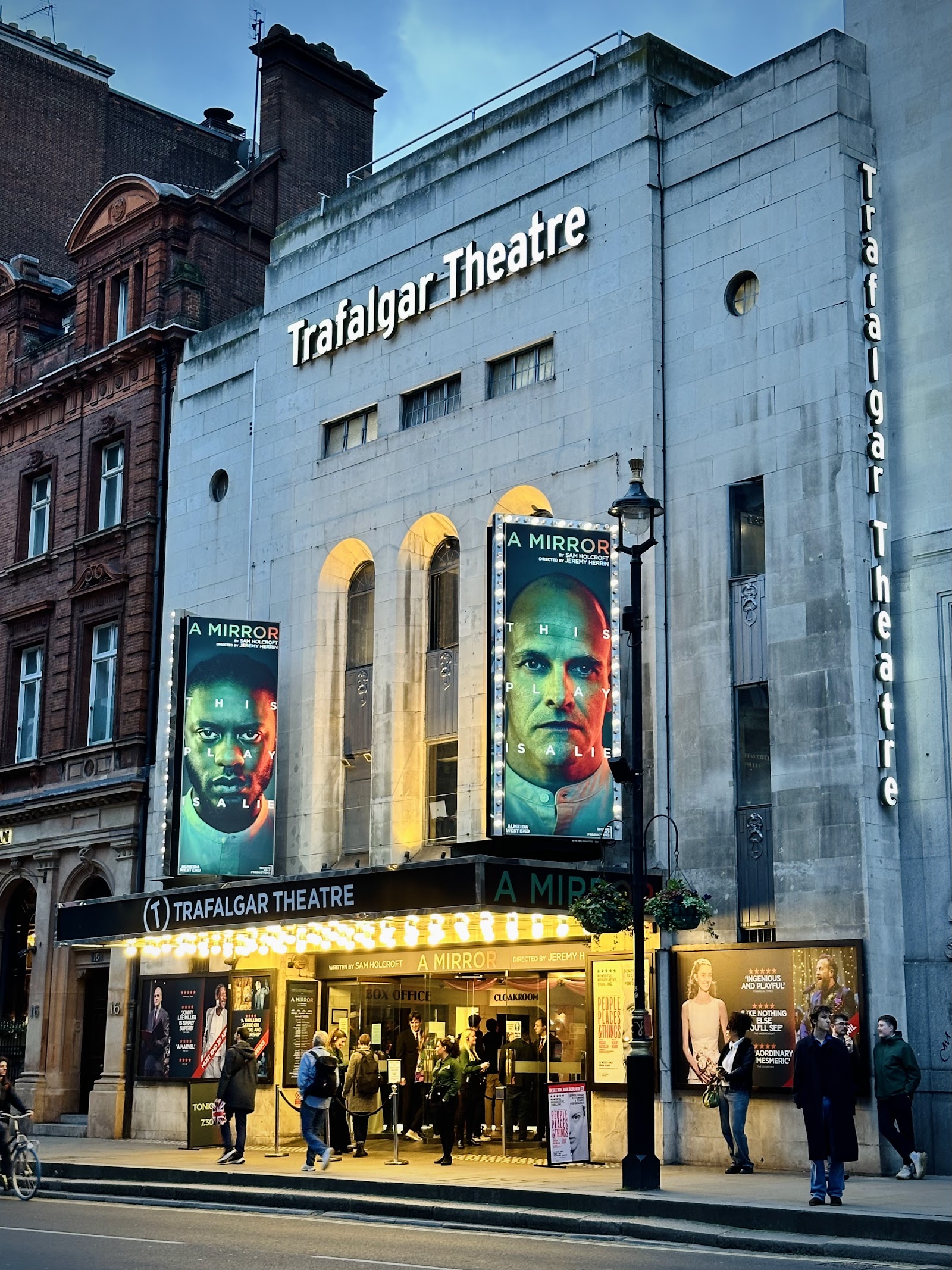
This is My Children! My Africa!, Athol Fugard's uncompromising look at generational change, education and the use of violence in political opposition in South Africa, at the height of the Apartheid era. Directed by Roger Mortimer and Deborah Edgington, this absorbing and disturbing revival, produced by Two Sheds, is now playing at Trafalgar Studios 2.
It is difficult to remember a recent production of a drama where the design elements played so profoundly important a role in the understanding of the production. It is almost as if set, lighting and sound are themselves characters in the narrative. Nancy Surman's set is remarkable. Its constant, symmetrical presence suggests order and oppression in equal measure, and a stifling sense of prolonged detention. The signs denoting entry by colour are not intrusive; their menace and horror lies in their everyday quality.
The set constantly reminds you that, at the time in question, South Africa was like this: an unyielding, harsh prison, where unspeakable things happened in the shadows, where white and black people were divided and kept in the dark, where change did not come fast enough. Darkness is a tangible force in the play and Jack Weir's exceptional lighting design ensures that darkness in all its forms is a constant - even when light shines or burns, Weir never lets you forget the presence and power of darkness. Levels of light ebb and flow, horizontally and vertically; shadows dance across faces, cover features, obscure action. The altered states of light and dark reflect or deflect the light and dark in character and speech. Fear and hope is conveyed expertly by Weir's control of the darkness.
And, all the while, punctuating and accenting plot developments or changes in the dynamics of relationships onstage, Erin Witton's sound design achieves its unsettling aim. Subtle often, sometimes erupting in violence or dissonance, Witton's soundscape allows Weir's shadows to waltz in Surman's barbed-wire hell. The fusion of these elements gives the entire production an operatic/balletic feel which eminently suits Fugard's flowery imagery and the grandiose aspects of the writing.
The play concerns three characters: a teacher and his two students. One of the students is a white girl from a well to do family. The other is a very bright black lad. The teacher has lived a hard life, devoted himself to teaching. The government's insistence that black students be taught separately and differently from their white counterparts has taken a toll on the teacher, Mr M (yes, he doesn't have the same last initial as Mandela for nothing) who is opposed to Bantu Schools (where inferior classes are taught to black students) and seeks, in gentle ways, to subvert the system.
He encourages special students with obvious talent. As the play begins, it is one of the occasions when Mr M's subtle rebellion is at work : there is a debate and the very bright black student, Thami, is debating the very bright white girl, Isabel. Mr M wants the two to work together, to learn together. He knows Thami will benefit from exposure to Isabel. He is right.
In one of the play's most glorious scenes, the two students challenge each other about their knowledge of English literature. They are very impressive, bandying about facts and quotes from the likes of Wordsworth; and the special joy that comes from playing off each other sees both of them excel, and the rapport, banter and one-upmanship in this scene could be that of colleagues at Eaton. Which, of course, is the point: nuture bright minds, whatever their background and skin colour, and excellence will follow.
But Thami's people have had enough and violence is on the agenda as the disgruntled and oppressed seek to force change. Thami is forced to take sides, to turn against the civil disobedience ways of Mr M. This leads to a struggle between Mr M and Thami, with Isabel a fractured, uncertain bystander.
Fugard's writing is grand in scale, pungent in detail, mesmerising in part but also fatally flawed. It is both revelatory and cosy and it does not rest easy in that strange configuration. The poetic side of the tale is remarkable but it sits uneasily with the harshness of the reality; at the same time, the clash of styles works surprisingly well, but there is a lingering dissatisfaction with form and purpose which detracts from the overall effect.
Superb acting can overcome these structural issues. While the cast here is quite wonderful in part, they are not quite equal to the task set by Fugard. They have to both embrace the faults in the writing and overcome them - and they nearly manage it. But there is a slight tendency to melodrama which haunts all three performances, perhaps stemming from the somewhat exotic writing, which tends to undermine the drama.
The best performance comes from Nathan Ives-Moina as Thami. He is beguiling as the black student who wants to be educated but who succumbs to peer pressure and changes his path. The very best scenes in this production (apart from the spirited Literature debate) involve his battle with himself about which path to take - Mr M's slow evolution or the ready disruption of violence.
Rose Reynolds and Anthony Ofoegbu are both in good form as Isabel and Mr M respectively, but both are prone to Eastenders moments of melodramatic indulgence. Two directors should have been able to keep performances on the focussed straight-and-narrow, so one assumes the result was intentional, and, if so, it is a misjudgment. Perfectly straight playing is what is needed to make the most of the text.
These are, however, quibbles. As a whole, set, lighting, sound and acting - it works. It is compelling and questioning. Although Fugard wrote it about South Africa, the play concerns any society or culture where people are treated differently, especially in relation to education. Given the UK's current assault on culture in schools and the class wars that define modern Britain, the play has resonances in many quarters - to NHS or not to NHS for one.
Fugard's play is about unfairness, irrational distinctions, and a failure of proper values. It's resonances extend well beyond South Africa.
My Children! My Africa runs at Trafalgar Studios2 until 29th August 2015
Stephen Collins is a contributor at British Theatre, covering West End productions, London theatre news, casting updates, and UK stage trends.
View profile and all articlesStay in the spotlight
Get the latest theatre news, reviews and exclusive offers straight to your inbox.